Master Data Management (MDM)

The MDM software for one trusted record of every customer, supplier and product

Master data usually lives in ERP, CRM and a few spreadsheets that never quite agree. Pimcore MDM brings it into one governed source, with clear rules and owners, so every system downstream works from the same facts.
MDM final
Gartner Peer Insights
Customers' Choice
4.6 / 5

Trusted by 118,000+ companies

Why it matters

Turn scattered master data into decisions you can trust

When every system keeps its own version of a customer or supplier, reports disagree and processes break. Here is what changes with one governed source.
  • Today: three systems, three versions One golden record per entity Pimcore brings records from ERP, CRM and files together, removes duplicates and keeps one consistent version that every team and channel uses.
  • Today: brittle point-to-point integrations Integrations that stay clean API-first onboarding and distribution, plus file and CSV imports for legacy systems, keep data flowing in and out without custom glue code.
  • Today: every change is an IT ticket A data model that fits your business Build and extend your model in a no-code interface. Add attributes, hierarchies and relations as requirements change, without rebuilding what is already there.
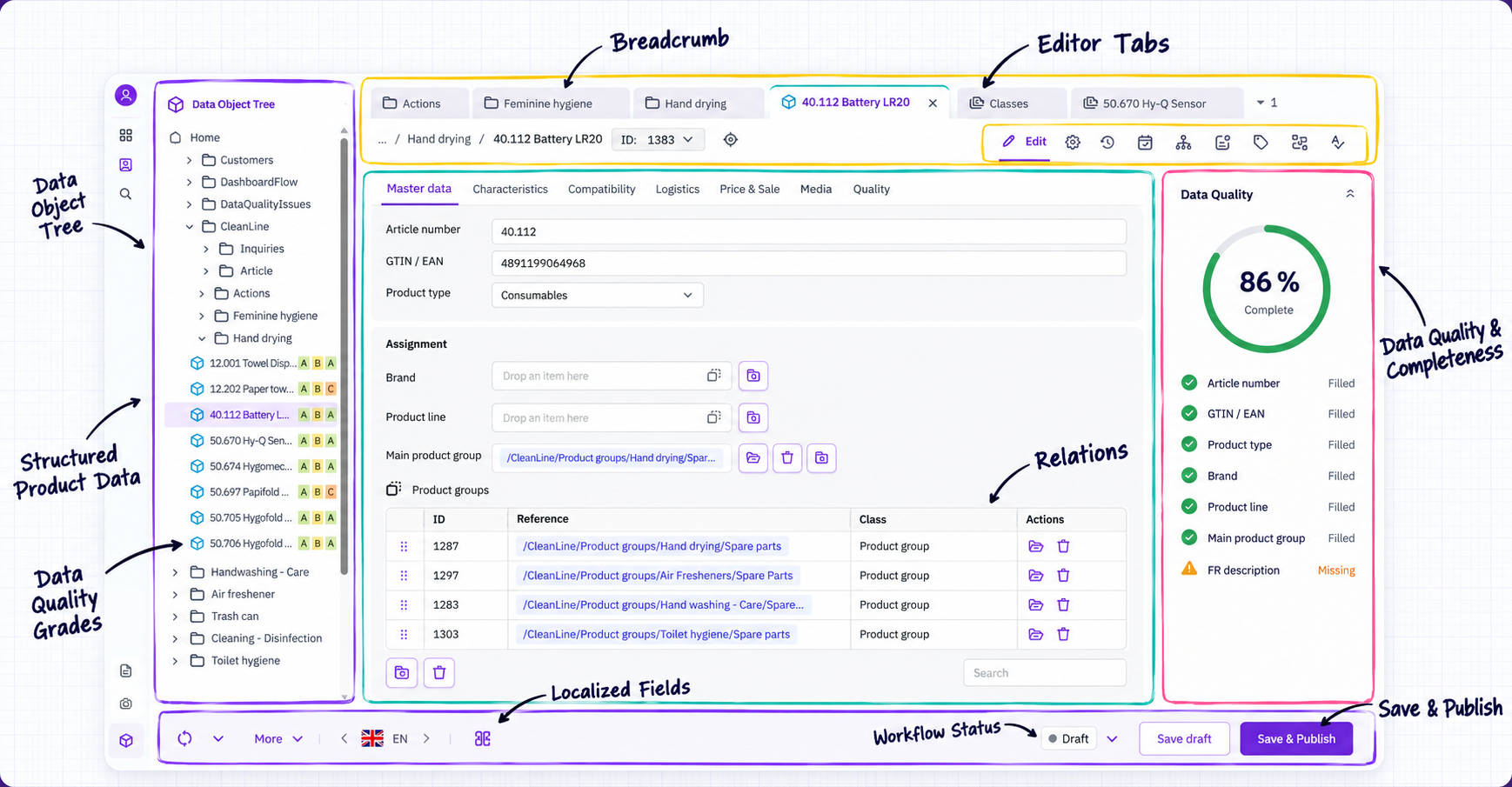
  • Today: quality is a matter of opinion Data quality you can measure Mandatory fields, validation rules and completeness checks stop bad data before it moves on. Quality becomes a number, not a debate.
  • Today: MDM programs run for years Value in months, not years Start with one high-impact domain, deliver the first use case end to end, then add the next. No big-bang project required.
  • Today: the vendor owns your setup Your data, your rules Pimcore's open-core platform gives you ownership of your master data and the freedom to connect legacy systems and new tools alike.

The capabilities behind Pimcore MDM

Six capabilities cover the core MDM job: modeling the data, getting it in clean, keeping it governed and sending it where it is needed.
Click any one to see how it works.

Pimcore's advanced data modeling allows businesses to create tailored, scalable, and highly adaptable data models for any industry. With over 45 customizable data components, Pimcore’s no-code interface simplifies the creation and management of complex data relationships across structured, unstructured, and binary assets.

Features

Pimcore unifies structured, unstructured, and binary data into customizable models, forming the backbone of a smart data management strategy. This powerful framework is central to Pimcore, making it the ideal solution for managing any data type, complexity, or volume.

Features

Pimcore’s integrated Data Quality Management offers a comprehensive toolset to ensure the highest standards of data quality, leveraging real-time reporting, automated enforcement, and AI-powered insights to maintain data integrity and accuracy.

Features

Pimcore’s API-first approach offers flexible and powerful tools for data onboarding, including integrated ETL processes, data matching, cleansing, and various interfaces like the Pimcore Data Hub and Product Experience Portals.

Features

Pimcore’s data distribution capabilities ensure efficient, real-time data sharing across various channels and systems. By leveraging flexible integration options and automated workflows, it streamlines data distribution for enhanced operational efficiency and consistency.

Features

Pimcore’s Workflow Automation centralizes and streamlines data and experience management with a sophisticated workflow engine, visual designer, and integration with third-party tools like Teams and Slack. Pimcore Copilot further enhances automation through AI/ML-powered assistance.

Features

Pimcore’s Analytics & Reporting capability allows for robust data analysis, monitoring, and reporting. Leveraging integrated dashboards and third-party tools, it provides invaluable insights into data quality and intelligence, enhancing decision-making processes across various domains.

Features

Pimcore DXP empowers businesses with smart multi-channel publishing, enabling seamless content management, delivery, and syndication across all channels—digital, social, mobile, print, and POS—with integrated AI/ML capabilities for transformative and personalized experiences.

Features

Pimcore's DAM centralizes and manages all media assets, providing a scalable, high-performance platform that integrates with your data and digital experience management strategies.

Features

Pimcore’s Brand Portals offer a centralized, customizable platform for managing and distributing brand assets, ensuring consistency across all channels.

Features

Pimcore's AI-driven automation with the Pimcore Copilot enhances data and experience management, ensuring businesses stay ahead of the competition. With integrations to tools like Power Automate, Zapier, and n8n, it delivers tailored automation, boosting efficiency, ROI, and time to market.

Features

Pimcore’s robust user management system supports large-scale data and experience management, offering secure SSO, 2FA, and detailed role and rights management down to the field and content level, ensuring compliance and security in global enterprise environments.

Features

Pimcore's Asset Experience Portals provide real-time access to digital assets, enabling seamless search, filtering, and sharing. Ideal for internal and external stakeholders, these customizable portals enhance collaboration and data management efficiency.

Features

Pimcore offers limitless extension and customization possibilities, empowering businesses to tailor every aspect of the platform to meet their unique challenges, thanks to its open-core architecture and flexible licensing.

Features

Not ready to talk yet?

The Hidden Cost of Untrusted Product Data

Duplicate records, conflicting attributes and manual fixes cost more than most teams expect. This whitepaper shows where the cost comes from and how a governed MDM approach brings it down.

Fits into the system landscape you already run

Thanks to Pimcore's API-first architecture, master data flows from your source systems into Pimcore and back again—without the need for any new development.

  • ERP

    SAP
    Microsoft Dynamics
    Oracle
    Infor
    Epicor

  • CRM & data sources

    CRM
    Data warehouse
    CSV / file import
    ETL

  • APIs & events

    REST
    GraphQL
    Webhooks
    Data Hub

  • Automation & AI

    n8n
    Zapier
    Power Automate
    MCP for AI agents

Results our customers can put a number on

  • Leviat GmbH

    Manufacturing

    Leviat GmbH uses DXP / CMS and PIM / MDM to deliver 30% TimeToMarket.

    • 30% TimeToMarket
    • 25% DuplicatedData
  • Bauli

    Food & Beverage

    Bauli uses DXP / CMS and PIM / MDM to deliver 50% DuplicatedData.
    • 50% DuplicatedData
    • 40% TimeSaved
    • 20% WebsiteTraffic
  • Auerswald

    Manufacturing

    Auerswald uses PIM / MDM and DAM to deliver 70% TimeSaved.

    • 70% TimeSaved
    • 25% EfficiencyIncrease
    • 50% DataRedudancies

Discover Pimcore’s MDM in Action

This demo offers just a glimpse. Pimcore’s real strength is its flexibility. For a tailored walkthrough specific to your industry, contact our team and see what’s possible for your business.
The 360° View
Part One
View Demo
Beyond Data
Part Two
View Demo
Data Excellence
Part Three
View Demo

Comparing Options

Weighing Pimcore against Stibo Systems?

An evidence-based, capability-by-capability comparison for enterprise MDM, including where each fits and how pricing works. No sign-up needed.

Pimcore Stibo Systems
  • Pimcore 33
  • Stibo Systems 37

Start with one domain, then scale

MDM does not have to be a big-bang program. Pimcore and a global network of certified partners deliver it in stages, starting where the impact is highest.
  1. Pick a domain Choose one high-impact domain, such as customer or supplier.
  2. Model & onboard Shape the model, then import, match and clean the source data.
  3. Govern Set validation rules, owners and approval workflows.
  4. Distribute & scale Publish via API, then add the next domain.

FAQs:

What is Master Data Management (MDM), and how is it different from PIM?

MDM creates one reliable source of truth for master data across systems and business domains. PIM focuses on product information that is enriched for marketing and omnichannel sales.

  • MDM: cross-domain (customer, supplier, location, product), focused on consistency and governance.
  • PIM: product-centric (attributes, copy, media, variants), optimized for channel readiness.
  • Together: MDM sets the overall master data strategy, PIM puts the product domain to work in markets and channels.
Can I run MDM and PIM on one platform with Pimcore?

Yes. In Pimcore, PIM, MDM and DAM share one data model. Product master data and channel-ready product content therefore do not need syncing between two systems.

What does Pimcore MDM cost?

Pimcore licenses by edition, not by record, user seat or API call. The Professional Edition is 9,900 $ per year and covers the commercial licence and Pimcore Store access. The Enterprise Edition is 29,900 $ per year and adds enterprise features, support and SLAs. Pimcore PaaS is quoted on your setup. Because nothing is priced per record, your licence cost stays flat as your master data grows.

Which data domains can Pimcore MDM manage?

Multiple master data domains on one platform: product data, but also customer, supplier, location and other master data.

  • Multi-domain: many entities, one governance approach.
  • Shared rules: validation, responsibilities and processes work the same across domains.
  • Fewer silos: one central place instead of islands in ERP, CRM and Excel.
How does Pimcore MDM manage product data across global markets and channels?

Product master data stays in one governed record that serves every market and channel, instead of a separate copy per region.

  • Linked, not duplicated: market and channel specific information hangs off the same record, so a correction does not have to be repeated per region.
  • Standards based: classifications such as ETIM or GS1 can be imported, extended and distributed per channel.
  • One set of rules: validation, responsibilities and approval workflows apply across domains and channels, so quality does not depend on who maintains which region.
  • Built for volume: the platform handles millions of complex data points as domains, channels and users grow.
What is a golden record, and how do you create a single source of truth?

A golden record is the one trusted version of an entity, built from all the systems that hold data about it.

  • Bring together: collect and combine data from different systems.
  • Clean and standardize: remove duplicates, contradictions and inconsistencies.
  • Govern: rules and ownership keep the record correct and traceable over time.
Why is MDM moving from monolithic suites to modular, API-first platforms?

Organizations need to integrate faster, deliver in smaller steps and involve business teams directly.

  • Integration by default: API-first reduces friction with existing systems.
  • Start small, scale fast: modularity replaces big-bang projects.
  • Faster value: focus on concrete use cases like data quality, matching or consolidation.
  • Business adoption: role-based governance lets business users contribute without an IT project for every change.
How does MDM integrate with ERP, CRM or a data warehouse?

Through API-first onboarding and distribution, and through file and CSV imports when legacy systems have no clean API.

  • Onboarding: ingest, transform and unify data from ERP, CRM or a data warehouse via API, ETL or file import.
  • Distribution: publish consistent master data to systems and channels.
  • Automation: scheduled imports, updates and workflows reduce manual effort.
Does Pimcore MDM support GraphQL and REST APIs?

Yes. MDM data can be exchanged via GraphQL and REST, and webhooks support event-based push and pull.

  • GraphQL: each system queries exactly the fields it needs.
  • Webhooks: changes such as an update or approval trigger downstream systems right away, which works well for orchestration with tools like n8n.
What does the open-core model mean for integrating Pimcore MDM?

The platform core is open, so integration is not limited to what a vendor chooses to expose. You can read the code, extend it and adapt an integration yourself.

  • Open interfaces: GraphQL, REST and webhooks are part of the platform, alongside ETL and file import for systems without a clean API.
  • Extend instead of wait: with access to the source code, custom integrations and transformations do not depend on a vendor roadmap.
  • Nothing priced per record: connecting another system or domain does not change what the licence costs.
  • One data model: PIM, MDM and DAM share it, so there is nothing to synchronise between them.
How flexible is the data model for complex hierarchies and relationships?

Pimcore models hierarchies, relations and cross-domain links, and grows with your requirements.

  • Built to grow: add attributes and structures as things change.
  • Linked, not duplicated: one consistent record instead of copies.
  • Industry standards: import or model classifications like ETIM or GS1, then extend them.
Which data validation and data quality features does MDM provide?

Validation rules, mandatory fields and integrity checks turn raw data into trusted master data.

  • Mandatory fields and rules: enforce completeness before data moves on.
  • No-code constraints: unique values, regex validation, required attributes.
  • Transparency: quality becomes measurable.
How are duplicates, matching and conflicts handled?

Pimcore supports matching, cleansing and consolidation to unify records from different sources.

  • Matching and cleansing: detect and clean duplicates during onboarding.
  • Consolidation and survivorship: merge data elements from several sources into one record, with rules that decide which value wins.
  • Governance: conflicts are resolved through defined approval workflows.
What is realistic in the first 90 days?

Time-to-value is fastest when you start domain-first and deliver one use case end to end. Whether that fits in 90 days depends on data readiness, source systems and scope.

  • Start small: one high-impact domain instead of a big bang.
  • Fast onboarding: import, transformation and validation reduce friction.
  • Scale iteratively: add domains and processes after the first win.
What is augmented MDM, and what can AI automate?

Augmented MDM uses AI, ML and automation to speed up typical MDM work, especially data quality, profiling and anomaly detection.

  • Anomaly detection: catch outliers before they spread into systems and reports.
  • Less manual stewardship: automation takes over repetitive data quality work.
  • Better insights: AI-supported profiling helps teams decide faster.
How are roles and permissions managed?

Access is controlled through role-based access control (RBAC) and permissions down to field level and content level, with SSO and 2FA. Users only see and change what they are allowed to.

Does Pimcore MDM support GDPR and audit logging?

Yes. An audit trail logs user actions, and governance features such as validations, mandatory fields and privacy checks support GDPR-related processes. That traceability matters for internal audits and regulatory requirements.

Can Pimcore MDM run on-premise, in the cloud or hybrid?

Yes. Pimcore runs in the cloud, on-premise or as PaaS, depending on your security, compliance and operating needs. In a hybrid setup you keep sensitive data under your own control and scale where it makes sense.

How does Pimcore MDM scale as data and users grow?

Pimcore is built for enterprise scale and handles millions of complex data points, even when data, domains and users grow at the same time.

  • Horizontal scaling: architecture and infrastructure scale with load.
  • API-ready: data stays consumable under heavy use, including headless setups.
Is Pimcore open source?

Pimcore is open core. The platform core is open and you keep full access to the code and to your own data. Professional, Enterprise and PaaS add commercial licensing, support and SLAs on top of that core. Your data model stays yours, whichever edition you run.

Get a demo fitting your requirements

Book a free guided tour with an expert, or explore on your own.
Try Pimcore Yourself
Receive direct access to a demo with pre-filled data across various modules.

We will use your personal data solely to process your request. For a better localized experience, we might share your data with certified solution partners in your geographical region. For more information, please read our privacy policy.

Back
Back